Sunday, 1 December 2013

Cornettos and Hobbits

Last night the Union hosted a film marathon that I went to see with a few of my friends, the Cornetto trilogy. Aside from the films themselves, it certainly felt like a marathon because the cinema seats are the most uncomfortable seats I have ever had to sit in-and I sat in my seat for six hours! Ok, we did have between-film breaks for a stretch and food. But still.

The Cornetto trilogy is three films starring Simon Pegg and Nick Frost: Shaun of the dead, Hot Fuzz, and The World's End. I had only seen the first two, and so was expecting the same old silly (but good) humour. The World's End surprised me, though. It was more serious than the other two, and had a dramatic back story that wouldn't usually go together with a group of old friends reuniting to have a second go at a popular bar crawl. Nevertheless, it worked well. I got a free tshirt, too.

Speaking of tshirts, I have started the fellowship challenge at the Hobbit pub (the best pub in the world). The challenge is to get all twelve Lord of the Rings themed drinks ticked off on the sheet they give you buy buying them. Once complete, you win a tshirt with the pub's logo, and the right to buy the thirteenth drink, the Nazgûl. So far I have four drinks stamped:
Gandalf
Elrond
Faramir
Fili

By far the worst rated drink is the Bilbo, an orange juice based cocktail with amaretto in it. It's disgusting, so the real challenge is drinking a whole pint of it. I had the unfortunate experience of tasting my flatmate's one, and it tastes like greasy orange juice. It was not great. On the plus side, though, the staff at the Hobbit are very friendly, and actively encourage the building of pyramids with the used plastic cups. Which is great fun.

Right, that's it for now, I have a fair amount of work to do. I'm looking forward to the Christmas holidays when I can see my family again (and sleep in a double bed!), I do miss everyone! But I'm having a really good time, so I can't really complain, can I?

Wednesday, 27 November 2013

Echinoderms and Asteroidea

Today we looked at Echinoderms, which include star fish (fun fact, the class name for starfish is Asteroidea. They're asteroids!) and sea urchins. The practical really shows the diversity of marine life, and you'll see in the photos I've posted. There are quite a few photos as I took some of specimens from the last practical, too. This has been one of my favourite practicals because I love the beauty of starfish and their radial symmetry. They are nice to draw, too.
I saw this on the shelf next to me when I was putting on my lab coat, and it's a squid so I must have missed it last lab when we covered molluscs. It's a shame because cephalopods are my favourite class so far!

This curious object is called the Aristotle's Lantern. It has absolutely nothing to do with light, it is in fact the "mouth parts" of a sea urchin- if you have the shell of one, it sits at the bottom where the large hole is. It is an extremely complicated structure and has five sharp teeth at the bottom, which are what enable it to be absolutely devastating to kelp forests!


This urchin has adapted to grow some of its spines into plates. These serve to absorb shock from large waves, so this species is found in places where there are frequent storm surges, and other organisms cannot survive.


I have always loved the simplicity of "sand dollars". I have a tiny fossilised one at home- they are a very old species!

This urchin has sulphur-using (I forgot the word, it's been a long day!) bacteria in its stomach that allow it to bury itself and survive deeper in the sediment than other organisms.


Also from the last practical is perhaps one of my favourite marine animals of all time- the nautilus! Its shell is adapted for buoyancy, and the way in which each segment inside the shell is curved (I can't remember if they are concave or convex) means that it is one of the strongest shells in marine biology. It can survive at depths of up to around 700m!

I'm not sure what this is, but it looks like a sand dollar trying to be a starfish. Or a paint splat.

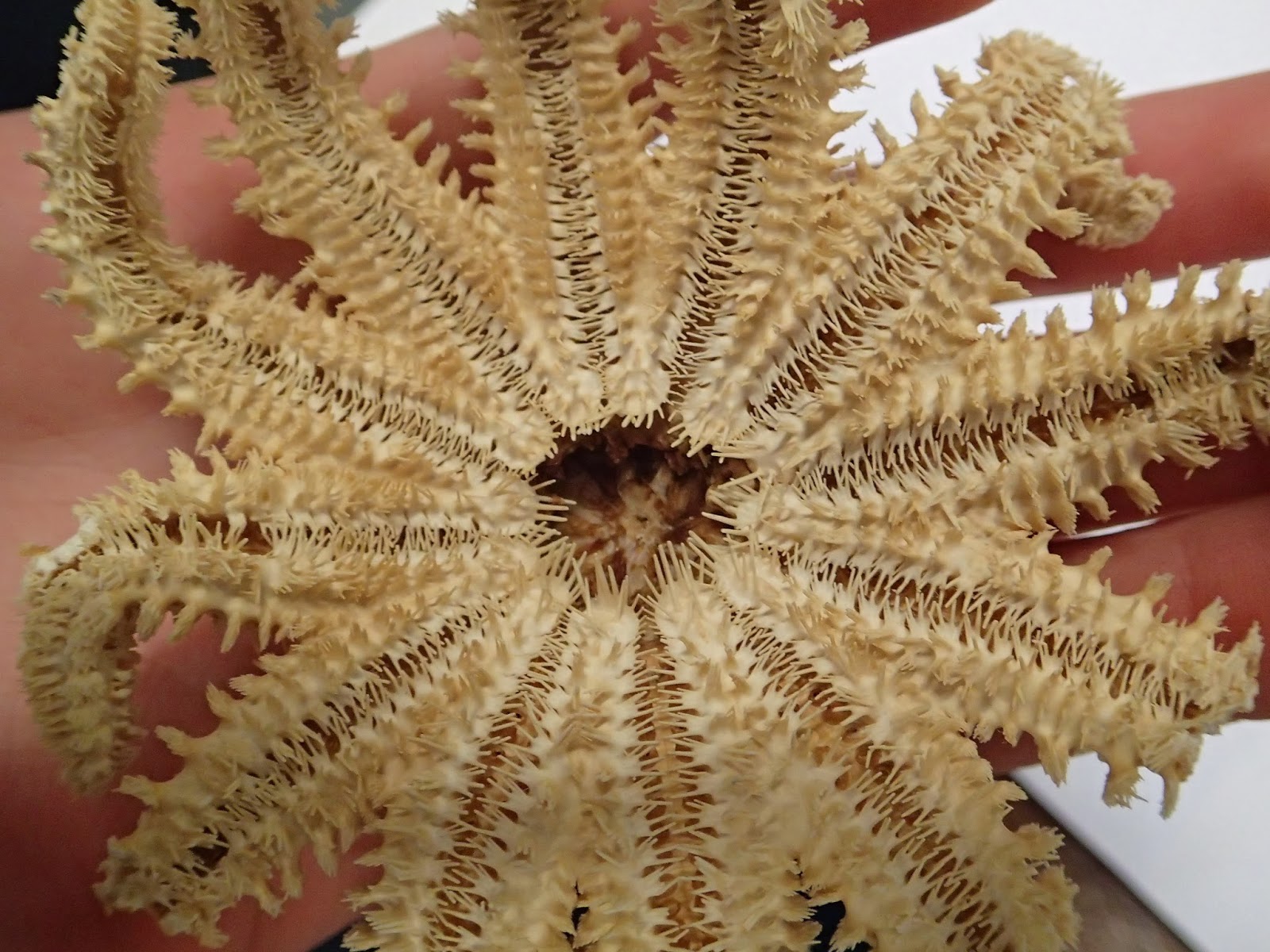
This thing is a basket star, my favourite specimen of the practical. It has many very thin, very tangly arms that are used to snare its prey and bring it towards its stomach, located in the flat central part in the left of the photo. The star then literally vomits its stomach out to digest the prey externally.

Not a single person- including myself- attempted to draw any of the basket stars, for good reason. Although I feel like I have been challenged, so I might give it a go later.


This is a crinoid (also known as a feather star), and I think they look rather beautiful. They resemble a stone flower when preserved like the one in the photo, but live ones look more colourful. They are in a different class to starfish, but the same phylum (Echinodermata). 

This (I think) is a large cushion star. Cushion stars have an enlarged central disc, with arms shortened so they are merely corners of a pentagon. I've always thought they look quite comfortable, but they are very knobbly and hard.

This is a close-up of the cushion star, revealing the rough, patterned surface.

This is what the Aristotle's Lantern looks like inside the sea urchin. It really is a peculiar structure, and it does somewhat resemble a lantern.


The underside of the sea star in the picture above.

Bits of brittle sea stars. They usually have very long arms which tend to snap off when in their dry form, which is why they have their nickname. In some very acidic oceans (caused by increased carbonic acid formed when CO2 is dissolved in seawater) if the sea stars try to move, their arms will snap off while they are still alive!

I found the curled arms of the basket star so beautifully complicated I couldn't really stop taking photos. I took 72 in the whole practical!


In the weeks between now and when the Christmas holidays start I will have some boat work, which I am looking forward to. The lecturer briefly told us we would get to see some of the organisms we saw in these practicals alive, so the camera will definitely be joining me! I will find out when this is happening, and may write another blog post before then if it is in a while.

That's enough from me for today, I'm off to the Hobbit for a Frodo.

Wednesday, 13 November 2013

Phylum Arthropoda

I'm not quite sure how long it's been since I last posted, but it feels like quite a while because I've had a few exams and I've been really quite ill, but I'm almost better now.

Today we had a practical on the phylum Arthropoda, which contains lobsters, crabs, copepods, shrimp, etc. Unfortunately I was a bit of an idiot and forgot to take the memory card out of my laptop, so I was only able to take a few photos, but I did some biological drawings to make up for it!

My favourite specimen was the horseshoe crab. It's an animal I am sort of familiar with, but I never knew exactly how big they could get- the specimen shown in the photo was roughly 15cm wide! My favourite drawing, though, has to be the lobster, simply because I think it went quite well.

The horseshoe crab with 15cm ruler next to it for size

My biological drawing of a smaller specimen

A look down the microscope at sea spiders, each one was no bigger than 1cm in diameter

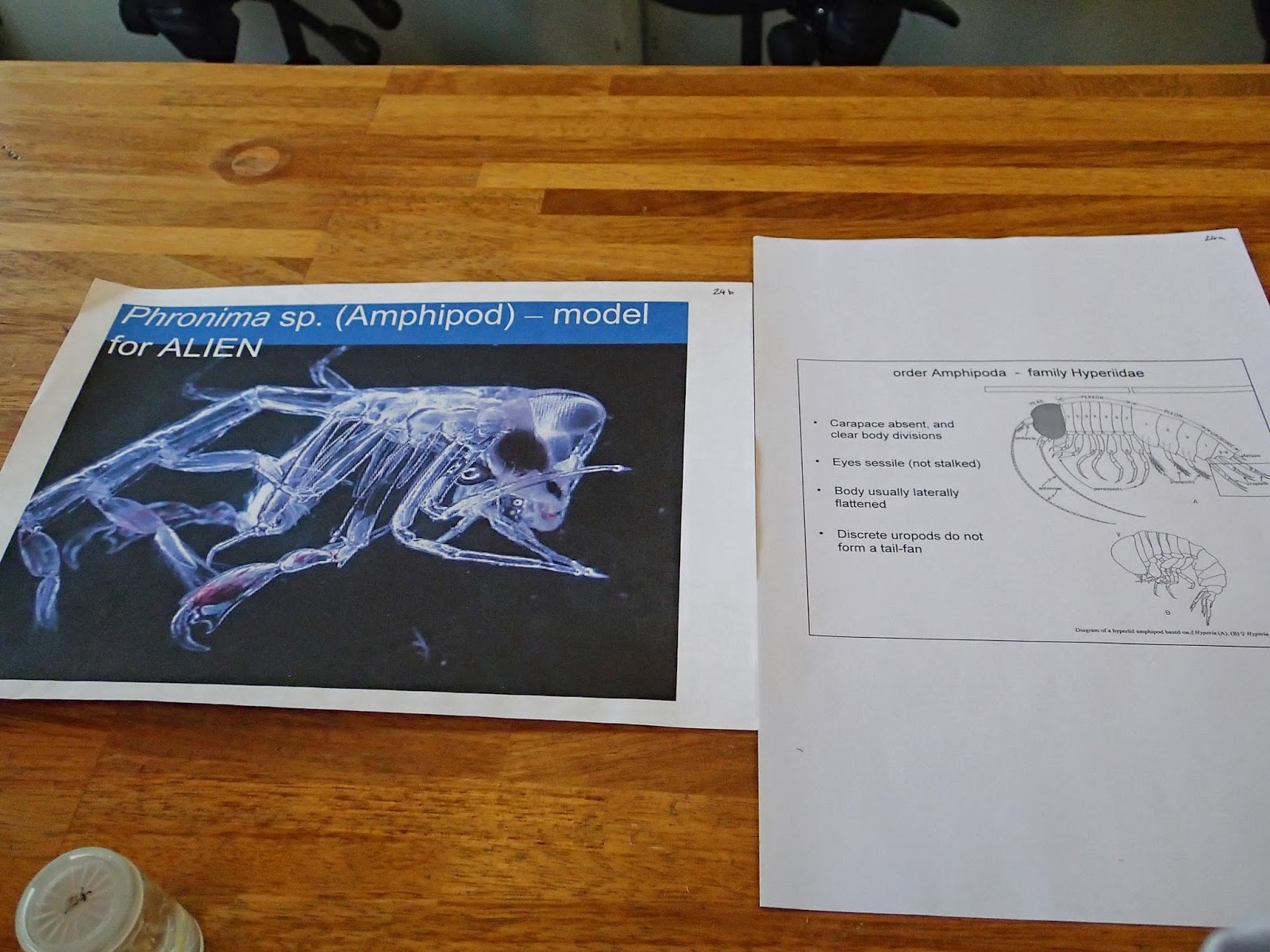
The resemblance isn't clear in this photo, but Phronima, pictured above, was the model for the famous Alien! The photo below gives a better idea of what it looks like.


The usual prawns you see on a plateau de fruits de mer, except these ones are certainly no longer edible.

I forgot to check the name next to this peculiar looking crab. I think it's rather cute looking.

Crab with the shell cut out to enable you to see it's anatomical structure. It reminds me of a book I had when I was small, though now I get to see the real thing!

My favourite model for my biological drawing. A group of us spent about half of the practical drawing this lobster, and listening to each other complain and grumble with frustration when bit and bobs didn't look right.

The finished product!

Probably the biggest lesson I learned today was that I will never look at seafood in the same way again- I see myself dissecting it or drawing on the napkin, and it makes just eating it seem messy. Apologies to the person I sit next to when we next have a family dinner involving sea food, because I will probably not be able to stop myself from talking about it!

Thursday, 24 October 2013

Annelida- Segmented worms

I had my second invertebrates practical today, and I got to practice my biological drawing (which I find oddly therapeutic). The organisms we looked at were from the phylum Annelida (comes from the Latin "ringed"), which are segmented worms. Not quite as cool a name as Platyhelminthes, the flatworms, but they can be equally as odd to look at. Phylum Annelida includes the lug worm, responsible for the nice squiggly sand patterns you see on the beach at low tide, and rag worms, commonly used as fishing bait.

The lab we were in had the faint smell of slightly mouldy fish, which was understandable considering all the specimens were dead and in trays under microscopes, right under our noses.

 This looks like a plant, but it is in fact a worm, and it is apparently found only around cold hydrocarbon seep sites on the upper Louisiana Slope in the northern Gulf of Mexico and form groups of hundreds to thousands of individuals. These worms harbour internal chemoautotrophic sulphide-oxidising (thiotrophic) symbiont. 

This was taken down a microscope (which is really quite hard to do well if you don't have an extremely steady hand), and it shows just how vast the size differences in segmented worms are. The picture below is a close-up shot, using the macro setting, of these worms. As you can see, they really are tiny- about 3mm long!


Here is the rag worm! this was a whopper, I think it was about 15cm long. These make up the majority of the worms farmed for the fishing bait industry. The picture below doesn't quite show the large, lethal looking jaws, but it does give some idea of how odd they look.


This rather cute thing is nicknamed the 'sea mouse', and you can see why. It is horribly difficult to draw biologically, as the only real feature you can see is hair, which you're not actually supposed to draw (because it's too much detail). My favourite part of this beauty is the iridescent hair round its sides.


This the organism responsible for the nice sand squiggles at low tide- the lug worm. It had a lovely set of gills, which looked like they were made out of shiny strips of copper. We learned last lecture that they build their casing by covering themselves in mucus and rolling around in their sand tunnel. Which quite frankly sounds disgusting.


This photo, again taken down a microscope, shows that the feature that defines Annelida, segmentation, can be really quite subtle. This specimen only shows a vague outline of its segments.

And here are my biological drawings from that practical:

In my ocean and earth systems lecture this morning, we learned about Snowball Earth, which has always been one of my favourite events in Earth's history. For those of you who haven't heard of it, it's a period of time in which Earth was completely covered in ice, and a series of volcanic eruption melted it back to what it is today. Snowball Earth is so significant because the reason why life survived the event was due to the properties of water- hydrogen bonding between water molecules makes it freeze less dense, resulting in ice being buoyant. Because it is buoyant, all the sea ice and glaciers developed on the surface, preserving and protecting life below the surface from the extreme temperatures above. 
It's really quite incredible that hydrogen bonds saved all life about 2 billions years ago- without them, there might not be humans here today.

On that bombshell, I'll leave it at that. Goodbye!

Wednesday, 16 October 2013

Photos

Bit belated, but I've been a little bit too busy/lazy to do this post lately!
Recently we did our first practical, which involved walking around the large lab, having a look at some dead (and live) specimens, and having a go at some biological drawing. Biological drawing is, in a way, easier than normal, artistic drawing, because it only requires features that help in the process of identifying the organism. The rules around how you draw the organism, however, are much more strict. For example, the brief guide we were given says that artistic shading is NEVER allowed.

I looked a bit weird dunking my camera into the anemone tank, but I managed to get some quite good photos in my opinion. I've also posted one of my biological drawings. There are a lot of photos, but I'll do my best to explain them!
 All these blue photos were taken from outside the tropical coral tank in the reception area, and it's a small exhibition of coral fluorescence under UV (which is why the tank looks blue)


 It took me quite a while to get a close up of the clownfish, as they moved quite quickly, and this is perhaps the best one. They look quite grumpy, which makes me a little more fond of them.

 By far my favourite photograph of all of the ones I took that day is this one. This is a young starfish, and it is only about 2-3mm across, which just shows you how good the macro setting can be now!

I got some strange looks taking these pictures, and someone even said "I do hope that's waterproof". Nevertheless, dunking an expensive camera into water is still unnerving.


This is a close up of a sponge. A lot of people know that bath sponges used to be made of actual sponges, but not many people know that to get them into a state so that you can use them, the fishermen had to beat the sponges on rocks to break up and wash out the spicules. More on spicules later.

This belongs to the phylum sipuncula. I Did a biological drawing of this, which I shall post here later

These are the spicules taken from a sponge. This photo was taken through a microscope eyepiece, which required patience and a steady hand! Spicules basically make up the skeleton of the sponge, though are not actually bones (which is why it's not an invertebrate). You don't want to use a sponge as a sponge if it still has its spicules, they're like shards of glass. Speaking of glass, spicules are usually made out calcium compounds, but in the rare deep sea sponges, they are silicates because calcium is dissolved much easier below 1500m. So deep sea sponges grow glass shards. How terrifying.

This is the "skeleton" of a sponge, with all its spicules in position. Below, you can see a close-up of this, but you still can't properly see the individual spicules. I love the pattern they make.


More spicules. As you can see, their shape varies quite a bit.

A close-up of coral. I do think their structure is really quite beautiful.


A "forest" of coral. This skeleton is what is left in bleached coral- when the surrounding water gets too hot for the coral, which then expels the beneficial algae (which gives coral their spectacular colours). The coral cannot live without the algae, so it dies, and its white skeleton is left.


This is an interesting story. This used to be feared by sailors because it resembled the bloated hands and feet of dead children (nice image). It's actually a sponge that grows on the shells of hermit crabs, and gradually dissolves their shell until it becomes their shell. This actual specimen had a large hermit crab in it once.

And here's the photo of said hermit crab, when it was alive!


This is a slice of Anemonia viridis, which is obviously an anemone. Below I have posted the sort of thing we were asked to do.


I quite like this one because of the blue bits, which to my understanding are part of the anemone's collar, retracted into bundles so the tentacles are out.


This is a close-up of the anemone's mouth. I'd never seen its mouth before, so this was particularly interesting. It didn't really do much aside wiggling the tentacle you see near its mouth.


I have yet to find out what this actually is. It's one of the strangest things I've seen in the reception tank, as each blobby thing looks like a lobster eye. The colours were amazing, too.


That's it for today, I hope you enjoyed the pictures. I have been told I have an invertebrates practical next week, too, so I'll bring my camera along to that too. The workload is slowly increasing, but I think I'm managing to keep on top of it. I enjoy the information in some lectures so much sometimes that we have discussions on the bus home while we wait for the freight train to cross.

I love it here, I feel like I am in my element! (But I am looking forward to coming home for Christmas. I miss my double bed). Anyway that's really it. I'll post sometime next week, as I've worked out the posting weekly works best for me. So long!